When God Doesn't Spare You
Article courtesy of The Scarlet Scribe
The question of theodicy, or “God’s justice” is deeply tied to the problem of evil and suffering. It is the most basic and primal question that all humans seek to answer: Why do bad things happen to good people?
I wager that wrestling with the problem of evil comes not from a philosophical space but from the reality of life. Something, usually random appearing, happened and that something was evil. Usually when we say that we mean “moral evil” as in someone, somewhere did something that they should not have done. This can range from someone cleaning out your life savings because the company was lying and “cooking the books” to the extreme horror of murder, child trafficking, and even genocide.
We have all wrestled with suffering in some way, shape, or form. While suffering is relative to some extent – someone cutting in line at the Starbucks can feel like suffering – most of us acknowledge that “real” suffering is much deeper and darker then that.
Imagine for a moment that you live around the year 2 BC. The exact time in history isn’t important as much as what is about to happen. You live in a tiny village in Judea. You have a bouncing, beautiful baby boy who is your world. You work hard. You love your family. You’re kind to others. You love God. Life is tough, food is scarce, but you’re happy.
And then come the soldiers, sent by a tyrant king you’ve never seen but are well aware of because you all live in the shadow of this ruler’s ability to wage violence at any time. The soldiers come and they take your little world, your little boy, and slaughter him right in front of you. There is nothing you can do. There are no police to call. No prosecutor to appeal to; no help is coming. All you can do is call out to God in your bitterness and pain, though that seems to fall on deaf ears.
This, I submit, is the real meaning of suffering, the real problem of evil that we all understand and live with and wrestle with if we allow it. Random evil, senseless evil, stupid evil. It’s poisoning a child for petty jealousy over TikTok likes, school shootings, a drunk driver wiping out a teenager driving safely, a senseless home invasion of a beloved elderly grandpa who spent his days helping others. It’s stories of genocide and struggle and trafficking and death.
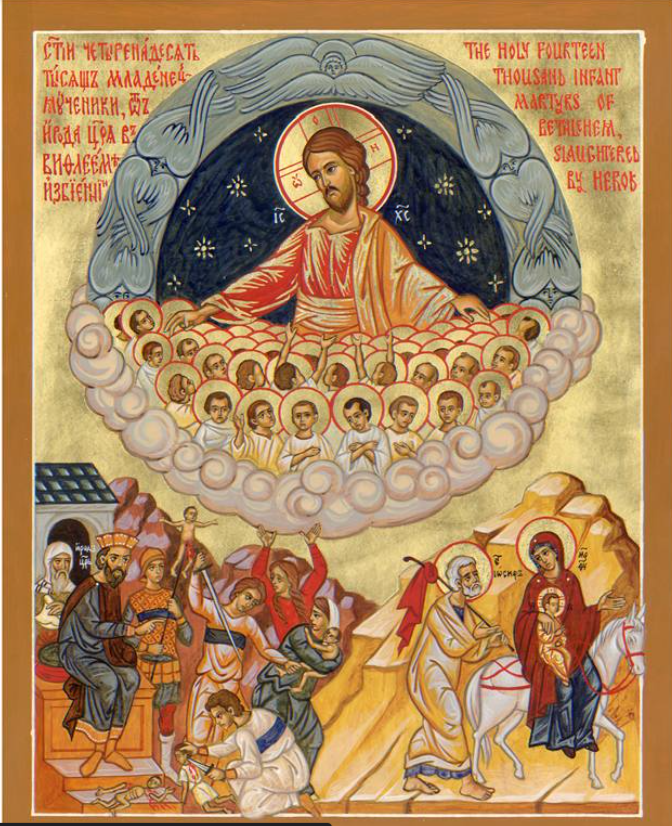
It’s a story Jesus knew and knew well. In fact, that bouncing little boy who was the world of some family in first century Judea was slaughtered right in front of his family because some king far away was hunting Jesus. This king, Herod, didn’t know Jesus by name. He didn’t know his family. He didn’t know where to look except in Bethlehem and for a male under two years of age. The information he received was from the “Magi”, wise men who came from the east to find the Messiah. He eliminated this “threat” from a child in the most brutal and senseless way:
Matthew 2: 16-18
16. Then Herod, when he saw that he was mocked by the wise men, was exceedingly angry, and sent out and killed ALL the male children who were in Bethlehem and in ALL the surrounding countryside, from two years old and under, according to the exact time which he had learned from the wise men. 17. Then that which was spoken by Jeremiah the prophet was fulfilled saying:
18. “A voice was heard in Ramah/lamentation, weeping and great mourning,
Rachel weeping for her children/she wouldn’t be comforted because they are no more.”
The author of Matthew parallels this with the prophecy from Jeremiah. It parallels a previous slaughter of innocents by Pharaoh, in Israel’s ancient past.
But for the families of the victims – the families of those now slaughtered beautiful, bouncing baby boys – no amount of Scripture will suffice the pain of senseless death. Their beloved sons are dead. And why?
We have no record of the families response; we can only imagine. These families died in grief not knowing WHO it was that King Herod was actually looking for in the first place. All they knew was some king somewhere wanted a toddler – a son that looked just like their own – dead. And more importantly – GOD DID NOT INTERVENE.
That last line is important to understand, so let me say it again: GOD DID NOT INTERVENE. Let that settle on you in the most uncomfortable way, as it should.
Those families lived the rest of their lives in grief – undoubtedly – and died not knowing the WHY. Why were their sons slaughtered for no reason? For no cause? And where was God?
The text tells us what God was doing. He was warning the holy family – Joseph, Mary, and little toddler Jesus – to depart and head to Egypt precisely BECAUSE Herod was coming with his soldiers. The holy family was warned. We have to reason from silence from the text, but reasonably the families of Bethlehem were NOT warned, otherwise they also would have fled.
God’s silence is critical in this. The WHY of God’s silence is more critical.
The children that were slaughtered in the Massacre of the Innocents – 14,000 by Church tradition and legend – are canonized as the first martyrs of the faith. These little boys died – literally – so Jesus could live. Their death did two things: it bought the holy family time to flee while the great tyrant’s soldiers were busy killing those innocent sons and it led Herod to believe that he had accomplished the wicked job and snuffed out the only hope that Judea would have had in this newly born Messiah. He was wrong.
Yet God did not intervene. He did not intervene because to do so would actually increase the danger to Jesus and the holy family. It would derail the overall mission and purpose, the beatific vision God had for the redemption of the world. It wasn’t that Jesus had to die; it was Jesus had to die at the right time and in the right way after doing the right things. A sword to the neck at two years old would not do. But it was enough to eliminate thousands of innocents sons and become called the Massacre of the Innocents.
We don’t talk much about this in our churches but the burden that the Lord Jesus had to carry with him...the burden of knowing that He lived and they died had to weigh on Him. He lived, they died. So often we talk about how He died for us. But those sons, those brothers, cousins, friends, kinsman of His...they died for Him so He could die for them later. And God did not intervene.
The point here is that the families could not, would not know the WHY. They died in grief not knowing the reason and many of them died long before Jesus began His ministry. God did not tell them the why just like He did not spare them from it.
We as readers and recipients of sacred text, the Bible, get to see the why. We get to see how the story slowly, painfully, plays out and we get to know the why. We see that it was a strategic, move-counter-move approach from the powers of darkness to the kingdom of God. It’s grisly and grim but the Bible doesn’t shy away from grim and horror. It highlights it and highlights God’s victory over the darkness, quite often THROUGH horror.
Golgatha is the place where Christ was crucified. The word translates to “Place of the skull” because of its shape. It was through darkness, through horror, through the grim that victory occurred. The place of death became the place that death lost.
It’s natural to ask ourselves where God is when there is suffering, pain, loss. It’s even natural and completely acceptable to ask why some tragedy happened. God’s big enough to handle it. Jesus Himself no doubt lived with the burden of their deaths all His life. The sorrow He had to feel – even decades later – had to remain with Him. 14,000 sons killed so He could live. Jesus, a Messiah full of compassion for the people and their suffering – how could He not carry the burden of what they gave up for Him? How did their deaths shape and form His sense of compassion and even His anger towards injustice? He carried them with Him in His very soul.
No, God did not spare them. He did not offer any explanation nor an apology even, as if He should. He only offered His Son, the final Word on every matter of suffering.
We often ask “why”. And Heaven is silent. Yet it is because we do not see all ends. We do not see the overall plan. We do not see that there is – sometimes – a greater good at play and that greater good may not, probably does not, depend on you accomplishing it.
In some ironic fashion the blood of those slain sons, those little bouncing beautiful baby boys still speaks. It speaks to us today. It teaches us that God does not always spare and that there is a purpose in it. It teaches us that your suffering does have value, it does have a purpose. It only seems senseless, random. Their blood invites us to think about yes, injustice, but also how the Lord Jesus Himself carried that burden all the way to Golgatha and back. They died so that He could live; He died so that we could live.
We owe the first martyrs of the Massacre of the Innocents a debt for they were chewed up and slaughtered so that the Savior could survive. It is right that the Church recognized them early on and canonized them immediately. Our forebears knew that they owed a debt and that those 14,000 sons paid the ultimate price to protect the child Jesus. We do too.
So when you wonder why suffering happens and God does not spare...think about the Innocents. Think about the silence that the families endured and hold fast, for there is a purpose in it. Your pain matters. Your suffering matters. You do not see all ends, yet that does not mean that it is senseless.
The Innocents feast day is December 28 where they are remembered and celebrated by the Church in all places that Christ is called Lord for their sacrifice.